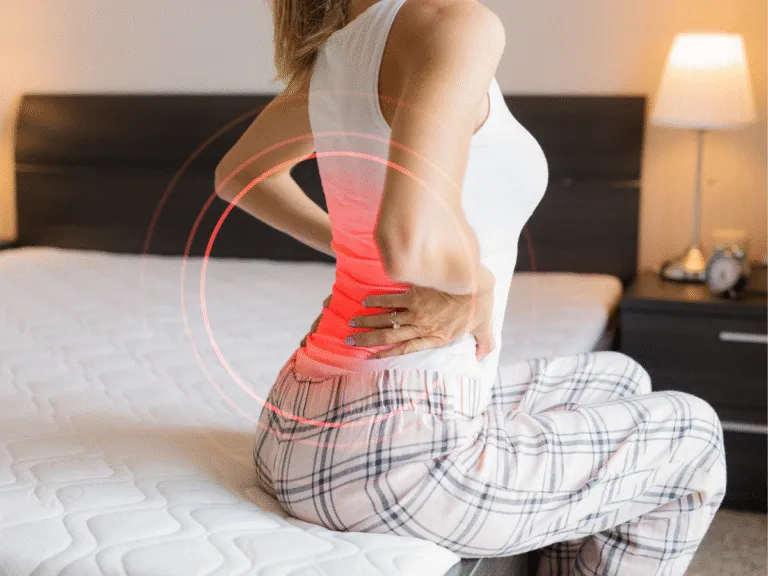
Better sleep isn’t about buying the perfect pillow or chasing a tracker score. The evidence points to boring basics: a body in neutral alignment, a consistent wake time, and a cool dark room. At The Barefoot Osteo in Warrnambool, we help you build sleep around how your body actually works.
📌 KEY TAKEAWAYS:
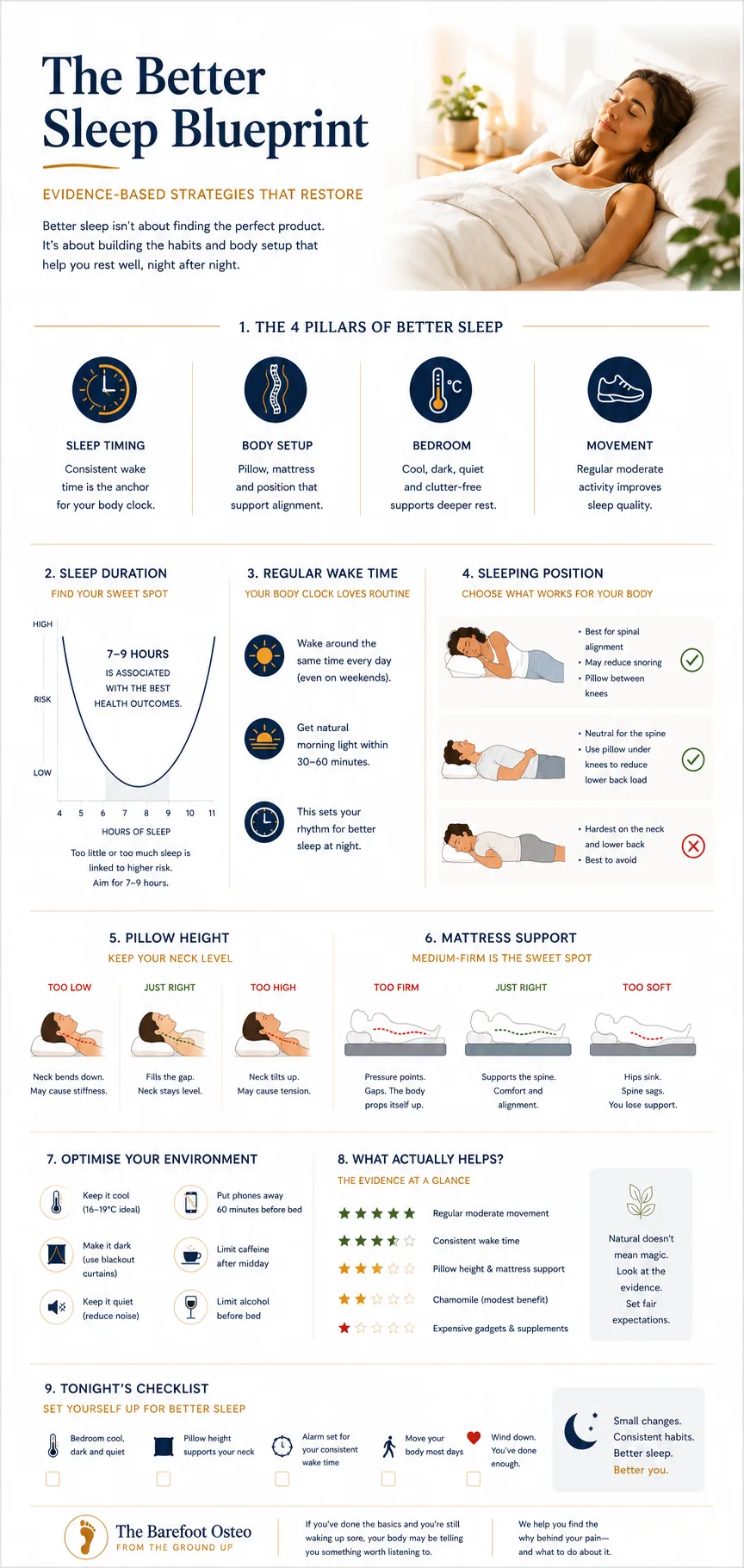
- Adults need a range — roughly 7–9 hours — not a magic number. And more isn’t automatically better.
- When you sleep may matter as much as how long. A regular wake time is one of the most underrated levers there is.
- There’s no single “best” pillow or mattress. There’s the right setup for your body and the way you sleep.
- The trackers and hacks are mostly the weakest lever. The boring basics are the strong one.
It’s 11:14pm.
The house is quiet. You should be asleep — you were tired at nine — but instead you’re lying there with the phone six inches from your face, the blue glow lighting up your chin, reading a review of a pillow that promises to fix your neck. It’s the third night this week you’ve done this. There’s already a pillow in the cupboard you sent back. There’s a mattress topper under the bed that didn’t do what the ad said either. And that tab — “best pillow for neck pain” — you’ve had it open for about a week now.
You keep thinking the next purchase is the one.
Here’s what I want to say to you, gently, as someone who sees the downstream of this every week in clinic: you’ve been treating sleep like a shopping problem. Like there’s an object out there, and once you find it and buy it, the good night unlocks.
But you’ve bought the objects. And you’re still awake at 11:14 reading about the next one.
So let’s try a different question. Not what should I buy — but what is my body actually doing at night, and how do I set it up properly? Because the sleep that genuinely restores you, the kind you wake up from without a stiff neck and a fog that takes two coffees to clear, doesn’t come off a shelf. It comes from how you build the night. And most of that is free.
This guide walks you through what the evidence actually supports — how much sleep you need, why when you sleep matters more than most people realise, how to set your body up with the right position and support, and where the gadgets and hacks quietly let you down. From the ground up, the way we do everything here.
You Don’t Have a Sleep Problem. You Have a Setup Problem.
Let me guess what’s in the cupboard.
A pillow that was supposed to be ergonomic. Maybe two. A weighted blanket that was too hot by February. A little bottle of magnesium spray. A sunrise alarm clock still in the box. And somewhere in your browser history, a genuinely impressive amount of research into mattresses you didn’t buy.
None of this makes you gullible. It makes you a normal person trying to solve a real problem with the only tools the internet keeps waving at you: things to buy. And you’re not alone in the struggle — two in three Australian adults report at least one sleep problem, and around 40% have reached for sleep medication at some point (Adams et al., 2017; AIHW, 2021). This is close to universal. It’s just that almost nobody talks about it at the school pickup.
Here’s the reframe, and it’s the whole article in one line: the problem was never that you owned the wrong things — it’s that no one showed you how to set your body and your night up in the first place.
That’s a setup problem. And setup problems have answers that don’t involve your credit card.
The reason this matters — the reason I’m a little fed up on your behalf — is that the shopping approach keeps you chasing. There’s always a better pillow, a smarter tracker, a newer hack. It’s a treadmill dressed up as self-care. The evidence-based basics, by contrast, are boring, unsexy, and they actually work. Let’s go through them.
How Much Sleep Do You Actually Need? (Less Than the Internet Insists — and Not More)
Eight hours.
You’ve heard it your whole life like it’s a law of physics. It isn’t. It’s a midpoint someone rounded to, and then a billion Instagram posts sanded off the nuance.
The actual recommendation, from the expert consensus panel that reviewed the evidence, is a range: 7 to 9 hours for most adults, and 7 to 8 for those over 65 (Hirshkowitz et al., 2015). A range. Because you are not the same as the bloke at the gym, and neither of you is a spreadsheet.
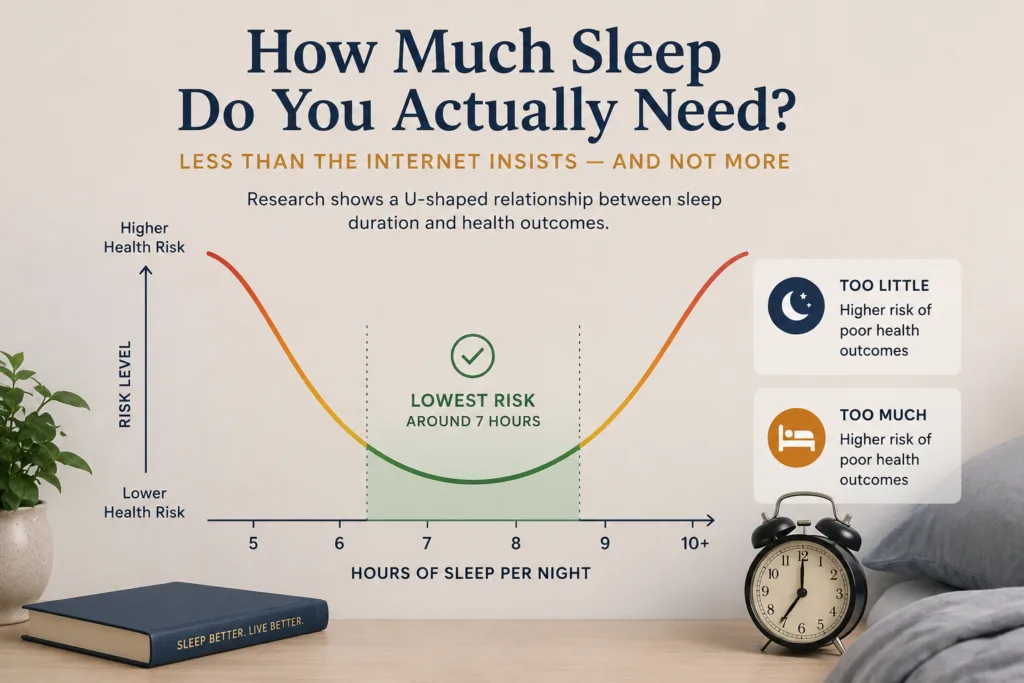
But here’s the part that stops people — and it’s the opposite of what the wellness world tells you. More is not better. When researchers pooled data across dozens of studies tracking millions of people, sleep and health outcomes formed a U-shape: risk was lowest at around seven hours, and it climbed again on both sides — too little sleep, and too much (Yin et al., 2017).
Sit with that for a second, because it quietly demolishes a habit half of us have.
The person who runs on five hours all week and then “catches up” with ten on Saturday isn’t fixing anything. They’re bouncing between two sides of the same curve. The catch-up sleep feels virtuous. Physiologically, it’s just a different kind of off.
You don’t need to chase a bigger number. You need to land, most nights, in the range — and then keep the timing steady. Which brings us to the thing nobody’s selling.

The Thing Nobody Sells You: A Regular Wake Time
If I could get you to change one thing about your sleep — one — it wouldn’t be the pillow. It’d be this.
Wake up at roughly the same time every day.
I know. It’s the least exciting sentence in this entire article. There’s no product attached to it, no subscription, nothing to unbox. Which is probably exactly why nobody talks about it. But the research on this is genuinely striking. When scientists at Monash University in Melbourne tracked over sixty thousand people using wrist monitors, they found that sleep regularity — the day-to-day consistency of when you sleep and wake — predicted mortality risk more strongly than sleep duration did (Windred et al., 2024).
When you sleep may matter more than how much. The most regular sleepers had a 20–48% lower risk of dying over the study period — not because they slept longer, but because their bodies knew when the night was coming.
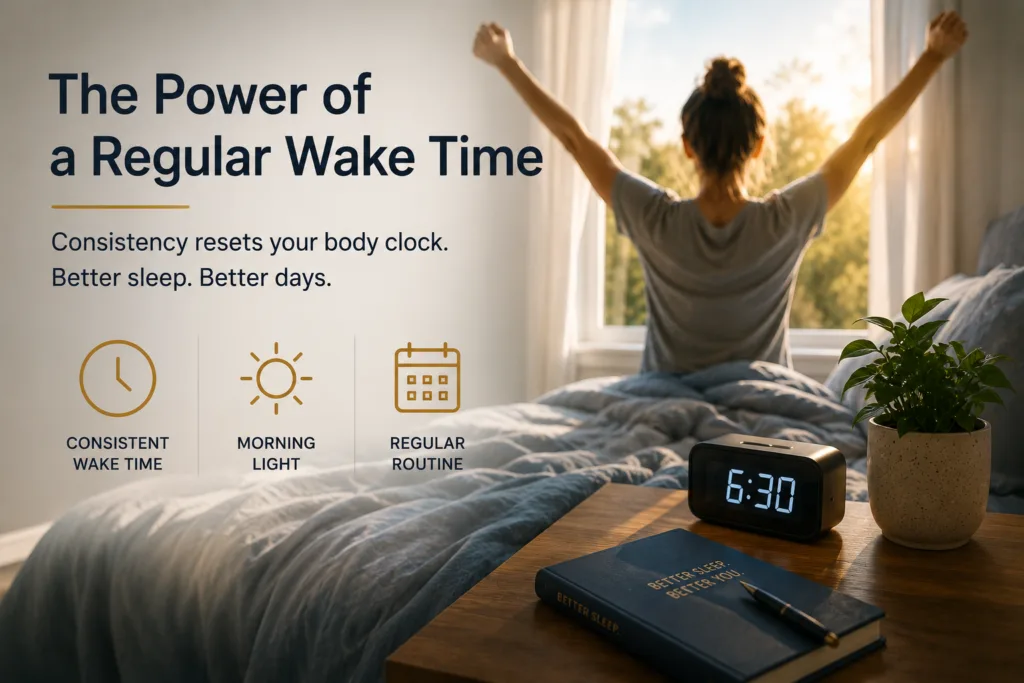
Your body runs on a clock, and that clock takes its cues from consistency. When you get up at 6 on weekdays and 9 on weekends, you’re essentially flying your internal clock to a different time zone every Saturday and dragging it back on Monday. It’s jet lag you gave yourself, without the holiday.
Now — I know the real-world objection, because I hear it from the nurses and the shift workers and the farmers and the 6am-gym crowd who fill this town. My schedule isn’t mine to control. Fair. If your start times genuinely rotate, perfect consistency isn’t on the table. But anchoring even your wake time as much as your roster allows — and getting light into your eyes soon after — does real work. You’re not aiming for monk-like precision. You’re aiming for a body that isn’t guessing.
When you sleep may matter more than how much. The most regular sleepers had a 20–48% lower risk of dying over the study period — not because they slept longer, but because their bodies knew when the night was coming.
Setting Your Body Up: Position, Pillow, Mattress
Right. Now the part you actually came for — because this is where a body that’s set up wrong will wake you stiff no matter how disciplined your bedtime is. And it’s the part I care most about, because it’s the part I can see on the treatment table.
Your sleeping position is a spinal-loading decision
You spend around a third of your life in one posture, held for hours, unable to adjust. That’s not rest for your spine — that’s load. And the position you hold changes where that load goes.
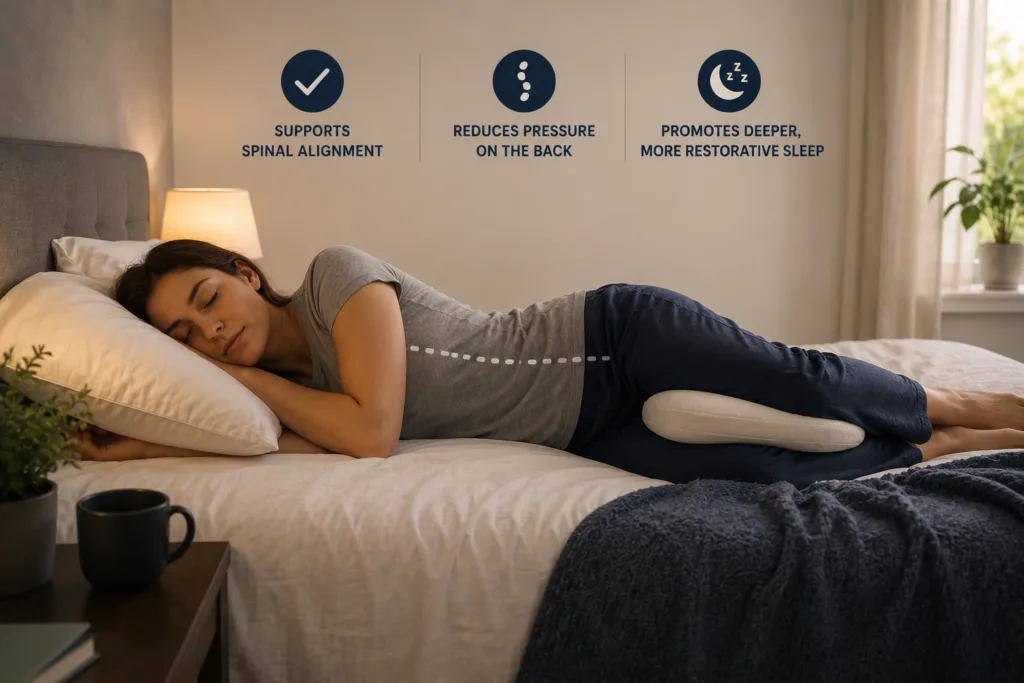
The evidence lands about where you’d expect: sleeping on your back (supine) or on your side with proper support tends to keep the spine in better alignment and is associated with less back pain — while sleeping on your stomach is the hard one (Saini et al., 2025). Face-down, you can’t breathe into the mattress, so your head stays cranked to one side for hours, and your lower back sags into extension. It’s a lot to ask of a neck.
If you’re a committed stomach sleeper and you’ve read this with a sinking feeling — you don’t have to fix it tonight. But it’s worth knowing your favourite position might be part of the conversation your body’s been having with you at 6am.
How to choose a pillow for your body (not off a list)
Here’s the thing the pillow ads won’t tell you: it’s not about the filling. Memory foam, latex, feather, buckwheat — the marketing is all about what’s inside. But when researchers actually measured it, the thing that governs whether your neck stays in neutral alignment is the pillow’s height and shape, not what it’s stuffed with (Chun-Yiu et al., 2021; Lei et al., 2021).
And the right height isn’t universal — it depends on your build and how you sleep (Lei et al., 2021). So here’s the principle, and you can test it against your own body tonight:
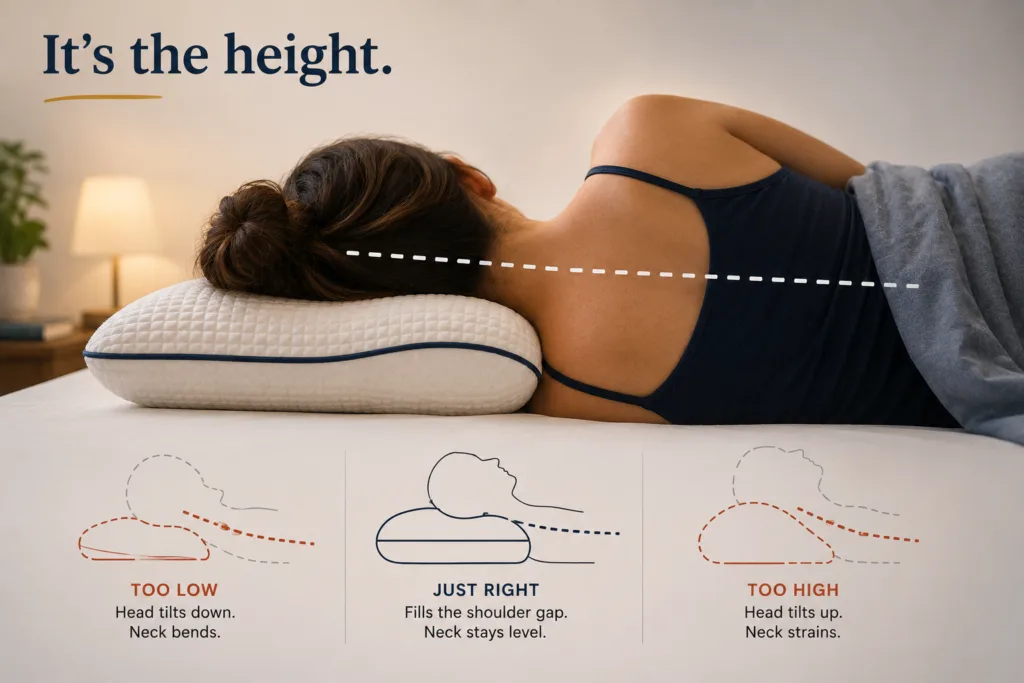
The job of the pillow is to fill the gap between your head and the mattress so your neck stays level — not tipped up, not dropped down. If you sleep on your side, that gap is bigger — the width of your shoulder — so you need more height. If you sleep on your back, the gap is smaller, so you need less. A pillow that’s perfect for a side sleeper will shove a back sleeper’s chin toward their chest all night.
That’s it. That’s the whole secret the returned pillow in your cupboard didn’t come with. There’s decent evidence that a well-matched pillow can actually change your neck posture and the endurance of the muscles that hold your head up (Fazli et al., 2020) — but “well-matched” is doing the work in that sentence, and matched means to you.
One honest caveat: if your neck already has some wear in it, the picture gets more individual, and no single pillow reliably wins (Gordon et al., 2019). That’s genuinely a “come and get it looked at” situation rather than a “buy this one” situation.
Firm, soft, or somewhere in between?
There’s an old belief — you’ve probably heard a parent say it — that a bad back needs a hard bed. A board under the mattress. The firmer the better.
It’s wrong.
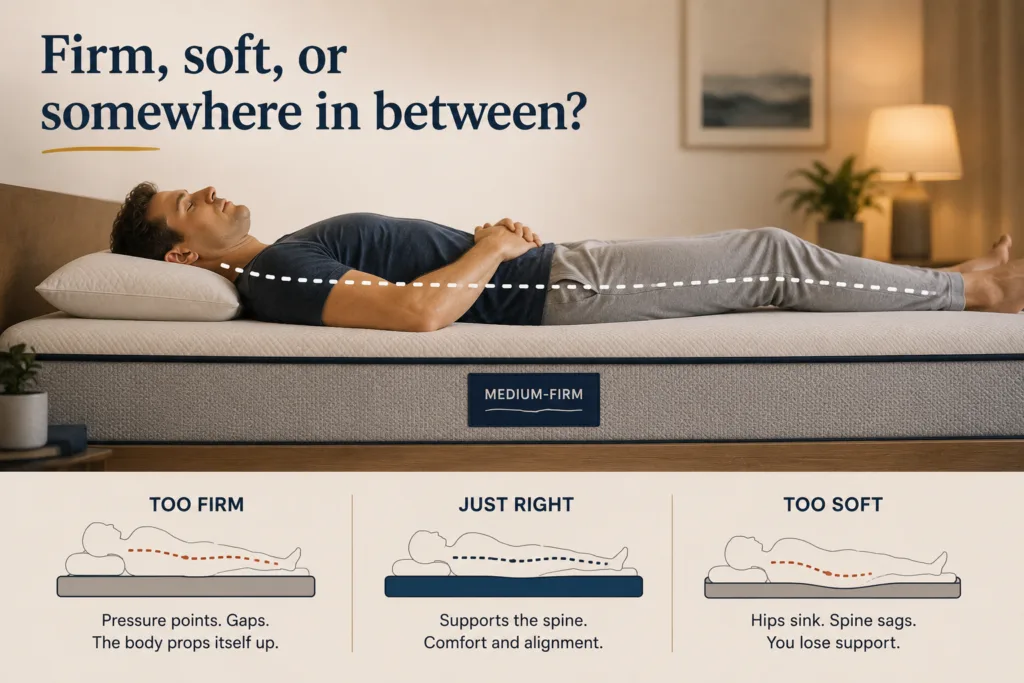
When the research on mattresses and back pain gets pooled together, the sweet spot isn’t extra-firm and it isn’t soft — it’s medium-firm, which supports the most comfort, the best sleep quality, and the best spinal alignment (Caggiari et al., 2021). A too-hard mattress leaves your hips and shoulders propping you up with gaps in between; a too-soft one lets you sag into a hammock. Medium-firm meets the body where it is.
Which means the answer to “what’s the best mattress” is the same as the answer to almost everything in this article: there isn’t a best one. There’s the one that’s right for your body — and it’s probably less extreme than you think.
If you’re waking up stiffer than you went to bed, that’s not just “getting older” — that’s your body telling you something about how it’s loaded overnight. Book a consultation and we’ll actually work out what’s going on. Book a consultation
The Room, the Coffee, and the Hour Before Bed
You can nail your position and still get sabotaged by the room.
Temperature is the one people underrate. Your body needs to drop its core temperature slightly to fall asleep, and a warm room fights that. The evidence points to somewhere around 20–25°C as the range where sleep runs most efficiently (Baniassadi et al., 2023). In a Warrnambool winter that’s easy. In a still February heatwave, it’s the difference between sleeping and lying there peeling the sheet off your legs.
Caffeine is the other one, and it’s sneakier than you think. That 3pm long black to get through the afternoon slump? Caffeine delays how long it takes you to fall asleep and cuts your total sleep — and it does it hours after the cup, because it lingers in your system far longer than the alertness does (Clark & Landolt, 2016). Older bodies clear it more slowly, too. If you’re sensitive, the afternoon coffee is a sleep decision dressed up as a work decision.
Then there’s the wind-down hour — dim the lights, get off the screen, let the body read the cues that night is coming.
But here’s where I have to be straight with you, because this is exactly where most sleep advice quietly overpromises. These habits — the ones everyone calls “sleep hygiene” — are necessary, but on their own they are not enough to fix real insomnia. When researchers graded the treatments for chronic insomnia, hygiene tips alone came out weak; the heavy lifting is done by structured behavioural approaches like CBT-I, delivered properly (Edinger et al., 2021; Furukawa et al., 2024). So if you’ve “done everything right” for months and you still can’t sleep, the answer isn’t a better wind-down routine or another gadget. It’s talking to your GP about a real, evidence-based program. That’s not failure. That’s using the right tool.
What About Natural Remedies?
I get asked this a lot — partly because I trained in naturopathy before osteopathy, so people assume I’ll either push the herbs or dismiss them. I’ll do neither. I’ll tell you what the evidence says.
Chamomile, for instance — the classic bedtime tea — actually has some support. When trials were pooled, it modestly improved sleep quality and reduced night-time waking. But it didn’t lengthen sleep or improve sleep efficiency (Kazemi et al., 2024). So it’s real, it’s gentle, it’s low-risk — and it’s not a sedative. Fair expectations are the whole game.
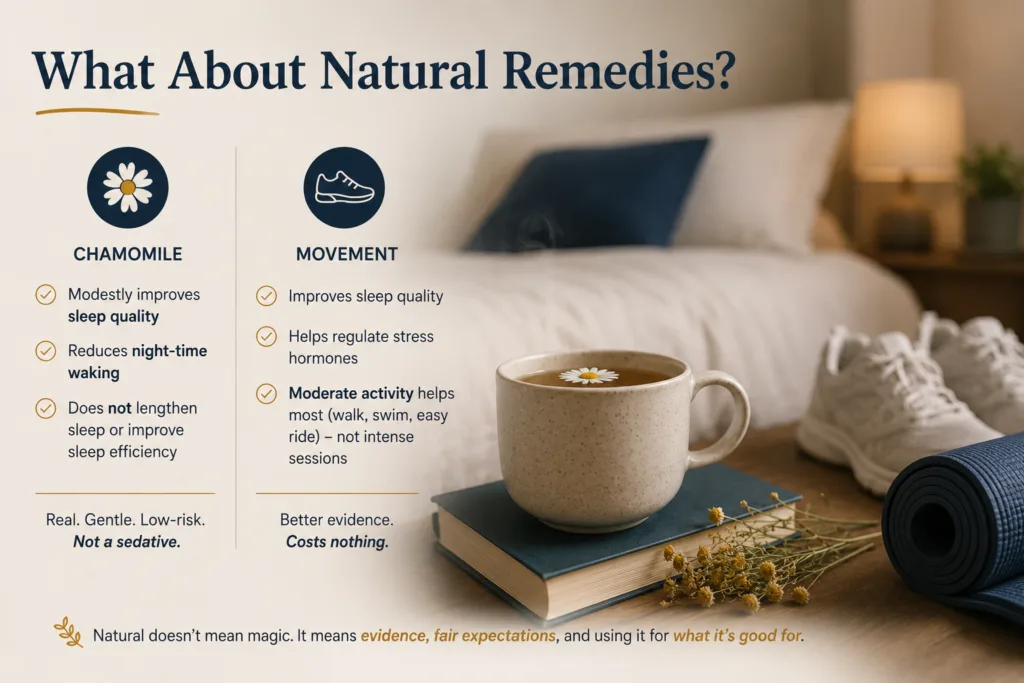
Movement is the one I’d actually push harder, because the evidence is better and it costs nothing. Regular physical activity improves sleep quality and helps regulate the stress hormones that keep you wired at night (De Nys et al., 2022). And here’s the part that suits the way most of us over 40 actually live: it’s moderate activity that helps sleep most — the walk, the swim, the easy ride — not flogging yourself in a high-intensity session, which can do very little for sleep or even backfire if it’s too late in the day (Zhao et al., 2023).
The through-line: natural doesn’t mean magic, and it doesn’t mean useless either. It means look at what the evidence actually shows, set fair expectations, and use the thing for what it’s good for. Which is exactly how I’d want you to treat every claim in this article.
So — back to 11:14pm. The blue glow, the returned pillow in the cupboard, the tab you’ve had open for a week. Here’s the quiet truth underneath all of it: the answer was never in the shop. It wasn’t a product you hadn’t found yet. It was a body you hadn’t set up yet, and a night you hadn’t learned to build.
And that’s the good news, because building is something you can actually do. A wake time you hold most days. A position that lets your spine rest instead of work. A pillow matched to your shoulders, a medium-firm bed, a cool dark room, and a coffee cut-off you can live with. None of it exclusive. None of it for sale at 11pm. This is your body, on your terms — not the pillow’s, not the tracker’s, not the algorithm’s. If you’ve been doing the shopping and still waking up tired and stiff, come in and let’s work out what your body’s doing overnight — and build the night that actually fits it.
📌 KEY TAKEAWAYS:
- 7–9 hours is a range, not a target — and consistency of your wake time is the underrated lever.
- Position first: back or well-supported side is kindest to the spine; stomach is the hardest.
- Pillow and mattress are “right for your body,” not “best” — height matched to how you sleep, and medium-firm over extra-firm.
- Gadgets and hacks are the weak lever. Setup, rhythm, and a cool dark room are the strong one.
Frequently Asked Questions
A: Sleeping on your back or on your side with good support tends to keep the spine in better alignment and is linked with less back pain, while stomach-sleeping puts the most strain on the neck and lower back (Saini et al., 2025). There’s no single perfect position for everyone, but if you wake up sore, your position is worth looking at — a side sleeper often just needs better support to fill the gap at the neck and between the knees.
A: The key isn’t the filling — it’s the height and shape, because that’s what keeps your neck level with the rest of your spine (Chun-Yiu et al., 2021; Lei et al., 2021). Side sleepers need more height to fill the wider gap at the shoulder; back sleepers need less. A good test: if your chin is pushed toward your chest or your head is tipped back, the height is wrong for you.
A: Neither extreme. The pooled evidence points to medium-firm as the best balance of comfort, sleep quality and spinal alignment (Caggiari et al., 2021). The old idea that a bad back needs a hard board isn’t supported — a mattress that’s too firm leaves gaps your body has to bridge all night.
A: For most adults, the recommended range is 7 to 9 hours, and 7 to 8 for older adults (Hirshkowitz et al., 2015). It’s a range, not a fixed number — and more isn’t better, as both short and long sleep are linked with poorer health outcomes (Yin et al., 2017). Consistency of timing matters as much as the total.
A: Melatonin is very commonly used, and for some circadian issues there’s reasonable evidence it can help shift the body clock — but it isn’t a general sedative, and it’s not a first choice for everyday poor sleep. Because dose, timing and quality vary a lot, and it can interact with other conditions and medications, it’s genuinely worth a conversation with your GP or pharmacist rather than self-prescribing. This is general information, not personal advice.
A: Morning stiffness often comes down to how your body was loaded overnight — position, pillow height and mattress support all play a part, and poor sleep itself can lower your pain threshold the next day (Stroemel-Scheder & Lautenbacher, 2022; Runge et al., 2024). If it’s a regular thing, it’s worth having your setup and your movement looked at together rather than guessing.
Experience the Barefoot Difference. Book a consultation
This information is general in nature and not a substitute for individual clinical advice.
REFERENCES:
Adams, R. J., Appleton, S. L., Taylor, A. W., Gill, T. K., Lang, C., McEvoy, R. D., & Antic, N. A. (2017). Sleep health of Australian adults in 2016: Results of the 2016 Sleep Health Foundation national survey. Sleep Health, 3(1), 35–42. https://doi.org/10.1016/j.sleh.2016.11.005
Australian Institute of Health and Welfare. (2021). Sleep problems as a risk factor for chronic conditions. AIHW. https://www.aihw.gov.au/reports/risk-factors/sleep-problems-as-a-risk-factor/summary
Baniassadi, A., Manor, B., Yu, W., Travison, T., & Lipsitz, L. (2023). Nighttime ambient temperature and sleep in community-dwelling older adults. Science of the Total Environment, 899, 165623. https://doi.org/10.1016/j.scitotenv.2023.165623
Caggiari, G., Talesa, G. R., Toro, G., Jannelli, E., Monteleone, G., & Puddu, L. (2021). What type of mattress should be chosen to avoid back pain and improve sleep quality? Review of the literature. Journal of Orthopaedics and Traumatology, 22(1), 51. https://doi.org/10.1186/s10195-021-00616-5
Chun-Yiu, J. P., Man-Ha, S. T., & Chak-Lun, A. F. (2021). The effects of pillow designs on neck pain, waking symptoms, neck disability, sleep quality and spinal alignment in adults: A systematic review and meta-analysis. Clinical Biomechanics, 85, 105353. https://doi.org/10.1016/j.clinbiomech.2021.105353
Clark, I., & Landolt, H. P. (2016). Coffee, caffeine, and sleep: A systematic review of epidemiological studies and randomized controlled trials. Sleep Medicine Reviews, 31, 70–78. https://doi.org/10.1016/j.smrv.2016.01.006
De Nys, L., Anderson, K., Ofosu, E. F., Ryde, G. C., Connelly, J., & Whittaker, A. C. (2022). The effects of physical activity on cortisol and sleep: A systematic review and meta-analysis. Psychoneuroendocrinology, 143, 105843. https://doi.org/10.1016/j.psyneuen.2022.105843
Edinger, J. D., Arnedt, J. T., Bertisch, S. M., Carney, C. E., Harrington, J. J., Lichstein, K. L., … Martin, J. L. (2021). Behavioral and psychological treatments for chronic insomnia disorder in adults: An American Academy of Sleep Medicine systematic review, meta-analysis, and GRADE assessment. Journal of Clinical Sleep Medicine, 17(2), 263–298. https://doi.org/10.5664/jcsm.8988
Fazli, F., Farahmand, B., Azadinia, F., & Amiri, A. (2020). The effect of ergonomic latex pillow on head and neck posture and muscle endurance in patients with cervical spondylosis: A randomized controlled trial. Journal of Chiropractic Medicine, 18(3), 155–162. https://doi.org/10.1016/j.jcm.2019.02.003
Furukawa, Y., Sakata, M., Yamamoto, R., Nakajima, S., Kikuchi, S., Inoue, M., … Efthimiou, O. (2024). Components and delivery formats of cognitive behavioral therapy for chronic insomnia in adults: A systematic review and component network meta-analysis. JAMA Psychiatry, 81(4), 357–365. https://doi.org/10.1001/jamapsychiatry.2023.5060
Gordon, S. J., Grimmer, K. A., & Buttner, P. (2019). Pillow preferences of people with neck pain and known spinal degeneration: A pilot randomized controlled trial. European Journal of Physical and Rehabilitation Medicine, 55(6), 783–791. https://pubmed.ncbi.nlm.nih.gov/31489809/
Hirshkowitz, M., Whiton, K., Albert, S. M., Alessi, C., Bruni, O., DonCarlos, L., … Ware, J. C. (2015). National Sleep Foundation’s updated sleep duration recommendations: Final report. Sleep Health, 1(4), 233–243. https://doi.org/10.1016/j.sleh.2015.10.004
Kazemi, A., Shojaei-Zarghani, S., Eskandarzadeh, P., & Hashempur, M. H. (2024). Effects of chamomile (Matricaria chamomilla L.) on sleep: A systematic review and meta-analysis of clinical trials. Complementary Therapies in Medicine, 84, 103071. https://doi.org/10.1016/j.ctim.2024.103071
Lei, J. X., Yang, P. F., Yang, A. L., Gong, Y. F., Shang, P., & Yuan, X. C. (2021). Ergonomic consideration in pillow height determinants and evaluation. Healthcare, 9(10), 1333. https://doi.org/10.3390/healthcare9101333
Runge, N., Ahmed, I., Saueressig, T., Perea, J., Labie, C., Mairesse, O., … De Baets, L. (2024). The bidirectional relationship between sleep problems and chronic musculoskeletal pain: A systematic review with meta-analysis. Pain, 165(11), 2455–2467. https://doi.org/10.1097/j.pain.0000000000003279
Saini, Y., Rai, A., & Sen, S. (2025). Relationship between sleep posture and low back pain: A systematic review. Musculoskeletal Care, 23(2), e70114. https://doi.org/10.1002/msc.70114
Stroemel-Scheder, C., & Lautenbacher, S. (2022). The effects of recovery sleep on experimental pain. The Journal of Pain, 24(3), 490–501. https://doi.org/10.1016/j.jpain.2022.10.009
Windred, D. P., Burns, A. C., Lane, J. M., Saxena, R., Rutter, M. K., Cain, S. W., & Phillips, A. J. K. (2024). Sleep regularity is a stronger predictor of mortality risk than sleep duration: A prospective cohort study. Sleep, 47(1), zsad253. https://doi.org/10.1093/sleep/zsad253
Yin, J., Jin, X., Shan, Z., Li, S., Huang, H., Li, P., … Liu, L. (2017). Relationship of sleep duration with all-cause mortality and cardiovascular events: A systematic review and dose-response meta-analysis of prospective cohort studies. Journal of the American Heart Association, 6(9), e005947. https://doi.org/10.1161/JAHA.117.005947
Zhao, H., Lu, C., & Yi, C. (2023). Physical activity and sleep quality association in different populations: A meta-analysis. International Journal of Environmental Research and Public Health, 20(3), 1864. https://doi.org/10.3390/ijerph20031864