Your feet do far more than hold you up. Every time they meet the ground they change shape, sense pressure and respond to movement. Research suggests changing what your feet are exposed to can change how they work, but that doesn’t make barefoot movement a cure or shoes the enemy. The more useful question is what your feet are being asked to do, and whether they’re prepared for it.
In Brief
• The sole of the foot is a highly sensitive surface that contributes information used during standing and walking. [1,2]
• Small muscles inside the foot respond when the foot is loaded and changes shape. [2,3]
• The arch running across the foot appears to contribute substantially to how stiff or adaptable the whole foot becomes under load. [4]
• Barefoot and shod walking are mechanically different, but different does not automatically mean better. [5]
• Foot strength can change with training and minimalist footwear, although evidence for wider benefits remains mixed. [6,7]
• The useful question is not whether everybody should go barefoot. It is whether your feet have enough movement, strength and tolerance for the job you are asking them to do.
It happens somewhere between the back door and the clothesline
October does something nice to Warrnambool.
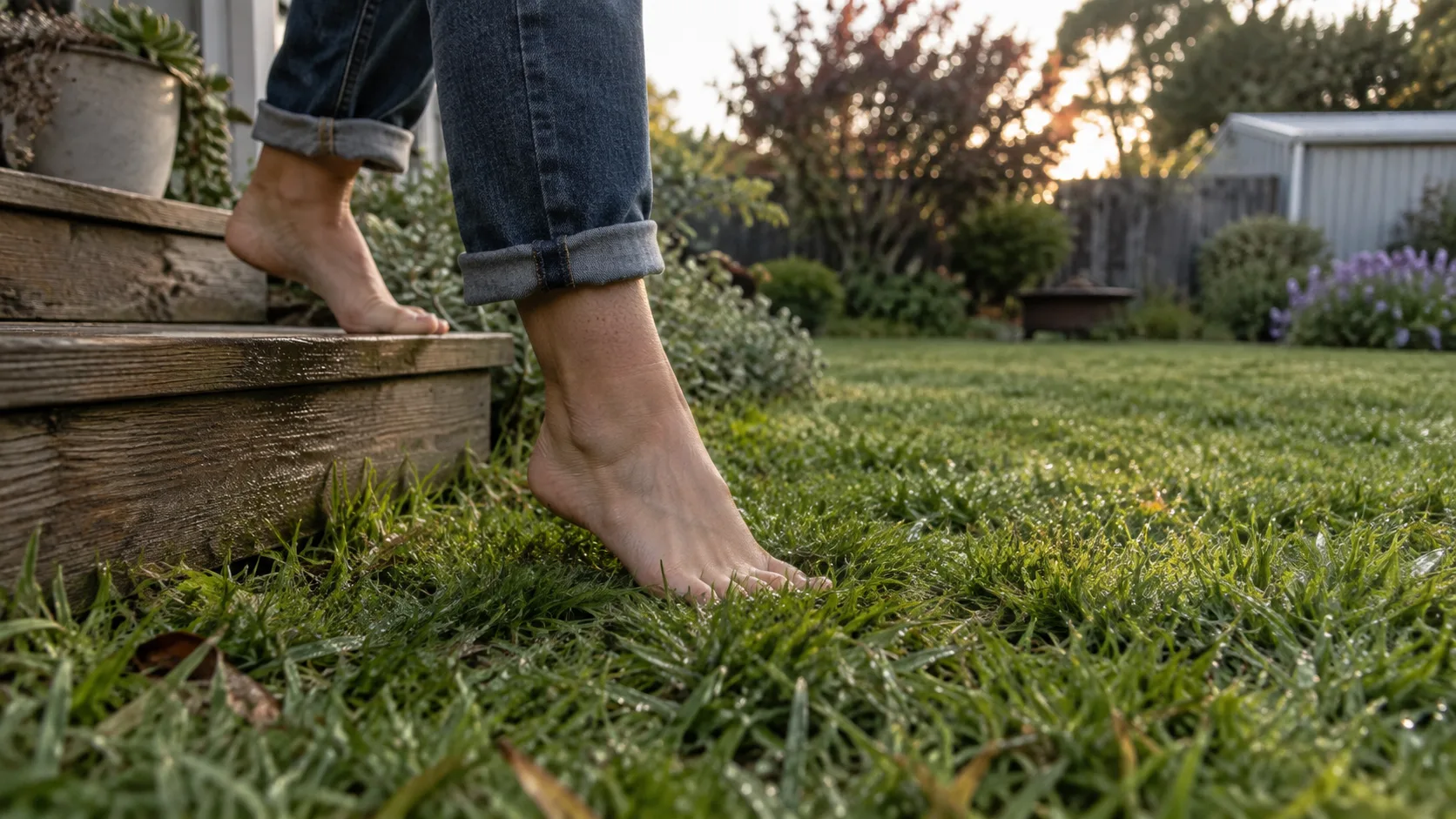
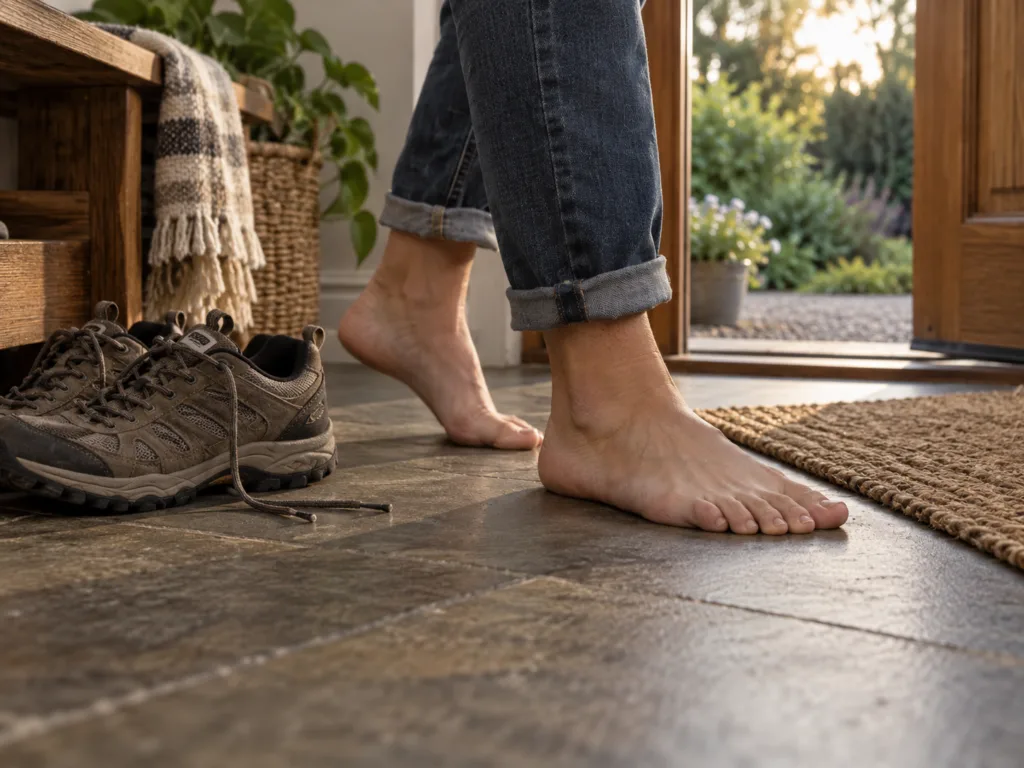
The evenings stretch out. The back door stays open. You wander outside to grab the washing, water something you have been meaning to water for three days, or stand on the grass while deciding whether the barbecue really needs cleaning tonight.
Somewhere between the kitchen and the backyard, the shoes stay behind.
You probably don’t give it another thought. But the moment your bare foot hits the ground, quite a lot changes.
Grass gives. Concrete doesn’t. One patch slopes slightly. Another is cool from the shade. Your weight moves forward while you reach for a peg, pressure shifts underneath you, the front of the foot spreads a little and the arch changes shape.
Most of this happens without you consciously noticing, which is probably just as well. Getting the washing in would become painfully slow if every footstep required a committee meeting.
But that ordinary moment hints at something I think we have underestimated about the feet for a long time.
Your foot isn’t simply a platform underneath the rest of you. It is part of the way your body gathers information about the ground.
And once you start there, the barefoot conversation becomes considerably more interesting.
Your feet are taking notes
Balance is often talked about as though it lives somewhere around the inner ear.
That is part of it. Your eyes contribute. Your inner ear contributes. Information from muscles and joints contributes. But the bit actually touching the ground is feeding information into that system too.
The sole contains several different types of pressure and movement sensors. Some respond when the skin first contacts the ground. Others keep reporting while pressure shifts underneath you. Together they contribute information your nervous system can use during standing and walking. [1]
The little muscles inside the foot are doing something interesting as well.
Researchers have recorded directly from nerves supplying these muscles while people were standing. Many of the sensors inside the muscles were fairly quiet while the foot was unloaded, then became active once the person stood up. In several, their firing changed alongside the natural movement of pressure underneath the foot as the person swayed. [2]
Standing still, it turns out, isn’t actually still.
Your weight is constantly moving by tiny amounts. Pressure shifts. Muscles respond. Your body makes small corrections without asking permission first.
There are also clusters of pressure-sensitive nerve endings around the front of the foot, particularly near the toe joints and surrounding soft tissues. [3] Add that to information coming from the skin and the small muscles underneath the foot, and the picture becomes much richer than “my foot touched the floor.”
The foot is sensing, moving and responding at the same time.
Now, it would be very easy to take that physiology and leap straight to, “Therefore barefoot walking improves your balance, fixes your posture and solves everything from the ankle upward.”
The research doesn’t give us permission to do that.
What it does allow us to say is that information from underneath and within the foot is part of the movement conversation. [1,2]
That’s enough to be interesting.
The foot changes shape for a reason
Most people know about the obvious arch running along the inside of the foot.
The one running across it gets considerably less publicity.
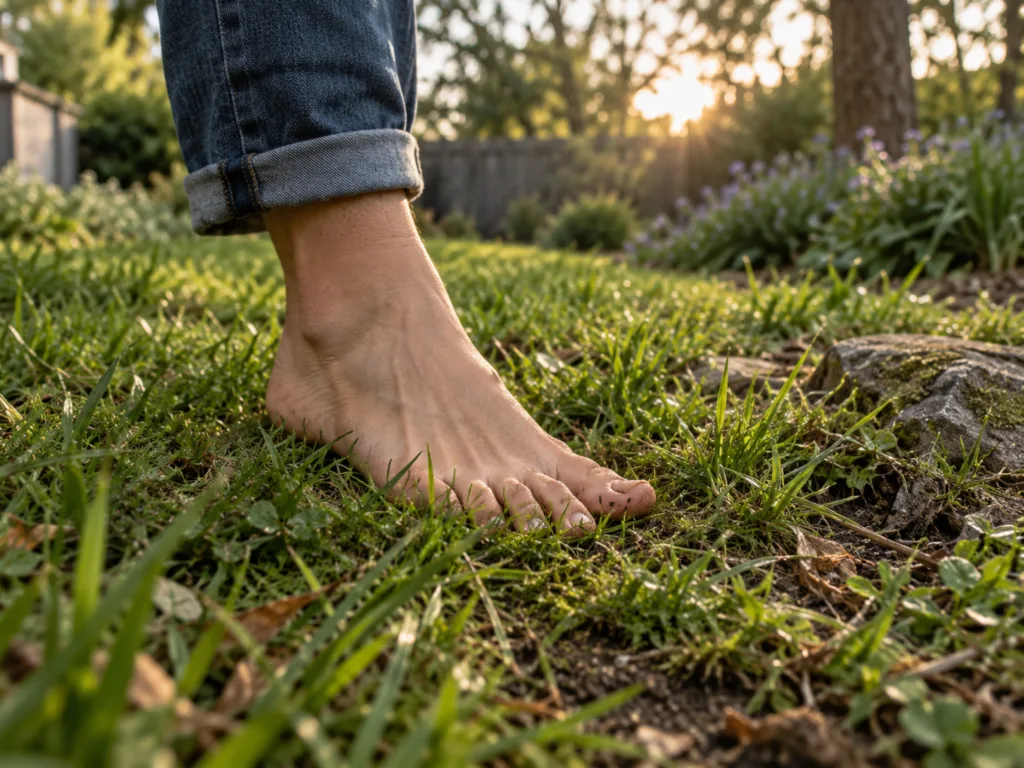
For years, I’ve been particularly interested in what happens across the front of the foot as it takes load. Watch someone standing or walking barefoot and those bones don’t behave like five fence posts hammered into the ground. The forefoot can spread and change shape.
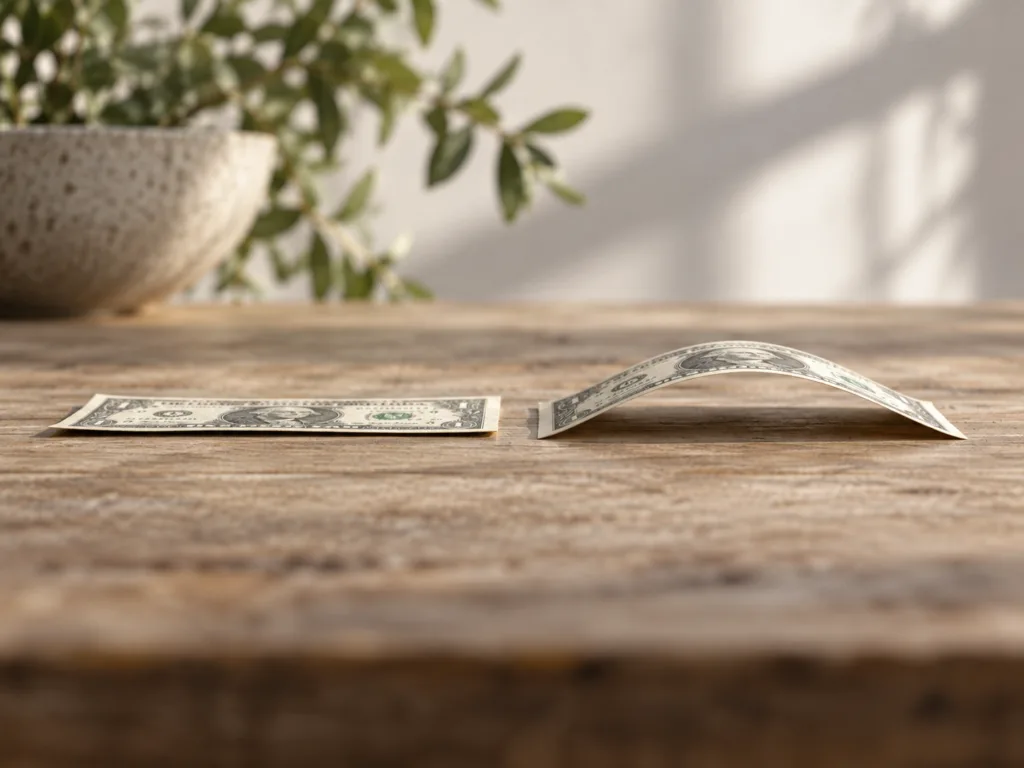
Research published in Nature gave that transverse curve much more importance than it traditionally gets. In their experiments, the arch running across the foot, together with the tissues between the long foot bones, accounted for more than 40% of the foot’s stiffness from heel to toe. [4]
Their analogy is better than any anatomy lecture I could give you.
Take a banknote and hold it flat. It flops.
Curve it gently across its width and suddenly it becomes much harder to bend lengthways.
Same piece of paper. Different shape. Different behaviour.
Your foot uses a version of that trick.
At the same time, the small muscles underneath the foot respond as the arch loads and changes shape. Their activity increases as the demand increases, and during walking and running they contribute to controlling how much the arch compresses and recoils. [8]
This is one of those places where research has sharpened something I’ve thought about clinically for years.
I’ve often considered the spreading of the forefoot and the tissues running between those bones as part of an “activation” mechanism. When I went looking harder at the anatomy, the story turned out to be less tidy than that.
Good.
Because bodies usually are.
The useful part probably isn’t one magic ligament flicking a switch. It’s the combination of skin being stretched and compressed, muscles changing length, joints moving and surrounding tissues taking load. [1,2,3,4,8]
The whole neighbourhood changes when the foot meets the ground.
That is a much better model.
I’m not neutral about barefoot movement
Let’s put that on the table.
I work barefoot. I’ve built much of my clinical philosophy around looking at movement from the ground up, and I think feet benefit from being given opportunities to move, sense and adapt.
So no, I’m not sitting perfectly in the middle of this conversation.
But I am also not interested in turning that belief into claims the evidence doesn’t support.
Barefoot movement does not automatically fix posture. It does not guarantee better balance. It does not prevent every injury. And taking your shoes off is not a treatment plan.
What I do think is worth preserving is the capacity of the foot to actually be a foot.
To move.
To load.
To sense.
To adapt.
Shoes can still be part of that picture.
Shoes change the conversation
This is normally where barefoot articles choose a team.
Shoes damaged us.
Barefoot is natural.
The ancestors did it.
Buy these $260 minimalist shoes and return immediately to your biological destiny.
I don’t find any of those positions particularly useful.
Shoes perform jobs.
They protect us from temperature, sharp surfaces and repetitive exposure. They make some sports and workplaces possible. They can redistribute pressure and provide structure when someone needs it. Victorian public health advice quite reasonably recommends choosing footwear according to the person, activity, surface and need for support. [9]
But putting something between your foot and the ground also changes the interaction.
A systematic review comparing barefoot and conventionally shod walking found differences in forefoot spread, stride length, cadence, foot placement, joint movement and pressure distribution. [5]
That’s worth understanding.
It isn’t proof that one condition is universally superior to the other.
Different is not the same as better.
A shoe might reduce one demand and increase another. Removing it does the same thing in reverse.
The useful question becomes: what job is the shoe currently doing?
That is a far better starting point than declaring either footwear or bare feet morally superior.
Your feet adapt to what you ask of them
This is probably the part of barefoot living I find most useful.
Feet are adaptable.
The muscles inside them respond to load. The arch changes under demand. Sensory systems respond to the environments they regularly encounter.
Several intervention studies have found increases in foot-muscle size or strength after people performed specific foot exercises or gradually spent more time in minimalist footwear. [6,7,10]
One six-month study reported a sizeable increase in measured foot strength in adults using minimalist footwear during normal daily activity. [10] Another trial found walking in minimalist shoes produced strength and muscle-size changes comparable with a specific foot-strengthening program. [6]
At first glance, that sounds like an open-and-shut case.
Then you zoom out.
A 2025 systematic review and meta-analysis included 28 trials looking at foot exercises and minimalist footwear. Some strength and biomechanical measures improved, but the researchers rated the certainty of much of that evidence as low or very low because of small study numbers, risk of bias and differences between studies. [7]
That distinction matters.
Your foot can adapt to changing demands. What we cannot confidently say is that every adaptation produces a meaningful benefit for every person.
A randomized trial published in August 2026 makes that point nicely. Healthy adults wore minimalist footwear for at least five hours per day for six months. Compared with conventional footwear, researchers found no significant advantage in the measures of static balance, dynamic balance or plantar footprint they tested. [11]
I actually like results like that.
They ruin the miracle story and leave us with something more useful.
The foot responds to demand, but adaptation is specific.
If you ask muscles to work differently, they can get stronger. If you expose the foot to different surfaces and loading conditions, the sensory and mechanical demands change.
That still doesn’t mean barefoot time automatically turns into better balance, fewer injuries, better posture or a healthier person.
Mechanism isn’t outcome.
Mobility. Stability. Balance. From the ground up.
This is where the barefoot idea fits into how I think about movement more broadly.
Not as a rule that says everyone should take their shoes off.
More as three questions.
Can the foot move?
Does the foot have enough available movement to change shape when it needs to?
That does not mean maximum flexibility. A useful foot also needs stiffness at the right time. The clever bit is being able to move when the task calls for movement and become firmer when the task calls for force. [4,8]
That’s mobility.
Can it control the movement?
Range without control isn’t terribly useful.
The small muscles inside the foot contribute to controlling the arch and responding to changing loads. [8] Strength and capacity are trainable, although how they should be trained depends on the person and the job. [6,7,10]
That’s stability.
Can the system use the information?
A foot doesn’t operate alone.
Information from underneath it joins information coming from the eyes, inner ear, muscles and joints as your body works out where you are and what to do next. [1,2]
Research into altering sensory input underneath the foot supports that broader idea. A 2025 systematic review found that changing plantar sensory input could alter muscle responses during gait, although results varied according to the population, task and where the stimulation was applied. [12]
That’s balance.
Not standing on one leg with your eyes closed because somebody on Instagram told you to.
Balance in the bigger sense: receiving information, organising it and responding appropriately to the task in front of you.
Mobility. Stability. Balance.
The ground just happens to be where that conversation starts.
So, should you spend more time barefoot?
For plenty of people, I think it’s worth exploring.
That is slightly different from telling everyone to throw their shoes away.
If you already wander around the house barefoot, garden without shoes or walk on the beach regularly, your feet are accustomed to some of those demands.
If your feet have spent twelve hours a day in work boots for twenty years, suddenly deciding that Saturday is Barefoot Day and walking ten kilometres on hard ground is a different proposition.
The issue isn’t whether barefoot is natural.
The issue is capacity.
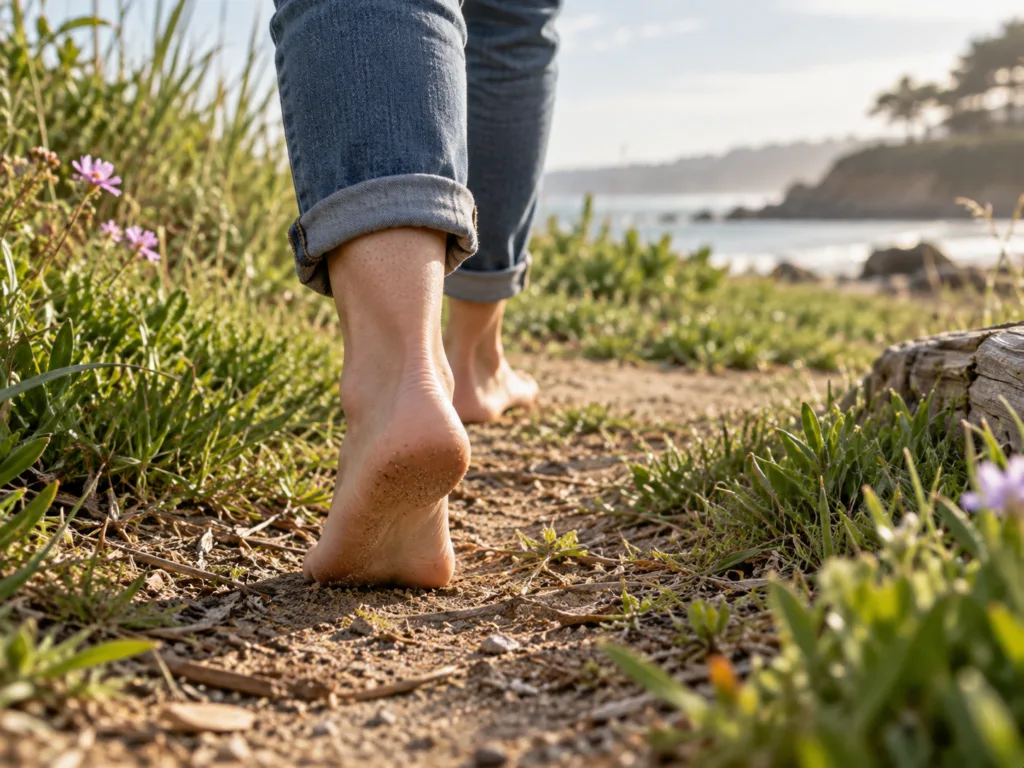
Skin needs time to tolerate different surfaces. Muscles and connective tissues need time to adapt to different loads. Your walking habits may change when footwear changes. [5,10,11]
And sometimes shoes are simply the right tool.
People with reduced sensation in their feet, circulation problems, active foot wounds, significant deformity or other medical considerations may need specific advice before increasing barefoot exposure. The surface matters too. A warm lawn and a workshop floor full of metal offcuts are not interchangeable life experiences.
This is why I prefer thinking about barefoot movement as exposure rather than ideology.
You don’t earn extra health points because you took your shoes off.
You’re simply asking your feet a different question.
Thinking about trying more barefoot time?
The useful bit is not taking your shoes off. It’s giving your feet time to adapt to a different demand.
Read the practical guide to transitioning to barefoot living →
The bit underneath us deserves more attention
For most of the day, our feet are almost invisible.
We put them into something at breakfast and rediscover them that evening.
Yet underneath the shoe is a structure constantly changing shape, responding to load and sending information back into the system above it.
Does that mean your feet secretly control everything?
No.
I’d be suspicious of anybody selling that story too.
But I do think they decide more than we usually give them credit for.
Not because barefoot movement is a cure, and not because shoes are the problem.
Because the ground is part of movement, and the feet are how we meet it.
Maybe that’s the better place to start. From the ground up.
Points Worth Remembering
- Your feet are both mechanical and sensory structures.
- The foot changes shape as it takes load, and the small muscles within it actively contribute to that process.
- The transverse arch across the foot appears to play an important role in overall foot stiffness.
- Shoes change the interaction between the foot and the ground. That change can be useful.
- Barefoot and minimalist exposure can change foot strength and mechanics, but that does not guarantee wider health or balance benefits.
- Capacity matters more than ideology. Different people, surfaces and activities place different demands on the foot.
Quick Questions
Is walking barefoot good for your feet?
It can provide a different combination of sensory input, movement and loading compared with conventional footwear. [1,5] Whether that is useful depends on the person, surface, amount of exposure and what their feet are accustomed to doing.
Does walking barefoot strengthen your feet?
Some studies of minimalist footwear and barefoot-style training have found increases in foot-muscle strength and size. [6,7,10] The broader evidence is still mixed, and stronger feet do not automatically mean better outcomes in every other measure.
Does barefoot walking improve balance?
Not automatically. Sensory information from the sole and small foot muscles contributes to standing and walking control [1,2], but a recent six-month minimalist-footwear trial did not find significant balance improvements compared with conventional footwear. [11]
Are minimalist shoes the same as being barefoot?
No. They generally reduce some of the structure and cushioning found in conventional shoes, but there is still material between the foot and the ground. Different minimalist shoes also vary considerably in flexibility, width, sole thickness and heel-to-toe drop.
Do I need to get rid of supportive shoes?
No. Shoes have jobs. The better question is whether the footwear suits the activity, surface and person wearing it. [9] Barefoot time can be one form of movement exposure without becoming a footwear religion.
References
- Strzalkowski NDJ, Peters RM, Inglis JT, Bent LR. Cutaneous afferent innervation of the human foot sole: what can we learn from single-unit recordings? J Neurophysiol. 2018;120(3):1233-1246. https://doi.org/10.1152/jn.00848.2017
- Knellwolf TP, Burton AR, Hammam E, Macefield VG. Firing properties of muscle spindles supplying the intrinsic foot muscles of humans in unloaded and freestanding conditions. J Neurophysiol. 2019;121(1):74-84. https://doi.org/10.1152/jn.00539.2018
- Germann C, Sutter R, Nanz D. Novel observations of Pacinian corpuscle distribution in the hands and feet based on high-resolution 7-T MRI in healthy volunteers. Skeletal Radiol. 2021;50(6):1249-1255. https://doi.org/10.1007/s00256-020-03667-7
- Venkadesan M, Yawar A, Eng CM, et al. Stiffness of the human foot and evolution of the transverse arch. Nature. 2020;579:97-100. https://doi.org/10.1038/s41586-020-2053-y
- Franklin S, Grey MJ, Heneghan N, Bowen L, Li FX. Barefoot vs common footwear: a systematic review of the kinematic, kinetic and muscle activity differences during walking. Gait Posture. 2015;42(3):230-239. https://doi.org/10.1016/j.gaitpost.2015.05.019
- Ridge ST, Olsen MT, Bruening DA, et al. Walking in minimalist shoes is effective for strengthening foot muscles. Med Sci Sports Exerc. 2019;51(1):104-113. https://doi.org/10.1249/MSS.0000000000001751
- Peters-Dickie JL, Detrembleur C, Guallar-Bouloc M, et al. The effects of foot core exercises and minimalist footwear on foot muscle sizes, foot strength, and biomechanics: a systematic review and meta-analysis. Clin Biomech. 2025;122:106417. https://doi.org/10.1016/j.clinbiomech.2024.106417
- Kelly LA, Lichtwark G, Cresswell AG. Active regulation of longitudinal arch compression and recoil during walking and running. J R Soc Interface. 2015;12(102):20141076. https://doi.org/10.1098/rsif.2014.1076
- Better Health Channel. Footwear for healthy feet. State Government of Victoria. Accessed September 2026. https://www.betterhealth.vic.gov.au/health/conditionsandtreatments/footwear-for-healthy-feet
- Curtis R, Willems C, Paoletti P, D’Août K. Daily activity in minimal footwear increases foot strength. Sci Rep. 2021;11:18648. https://doi.org/10.1038/s41598-021-98070-0
- García-García D, Llamas-Ramos R, Alvarado-Omenat JJ, Correyero-León M, Llamas-Ramos I. Effects of minimalist footwear on postural stability, plantar footprint, and safety in healthy adults: a single-blind randomized clinical trial. Appl Sci. 2026;16(17):8475. https://doi.org/10.3390/app16178475
- Trotman M, Ha PL, Tucker K, Cattagni T, Hatton AL. The effects of plantar surface stimulation on neuromuscular responses during standing balance and gait in healthy and clinical populations: a systematic review. J Electromyogr Kinesiol. 2025;82:103007. https://doi.org/10.1016/j.jelekin.2025.103007